
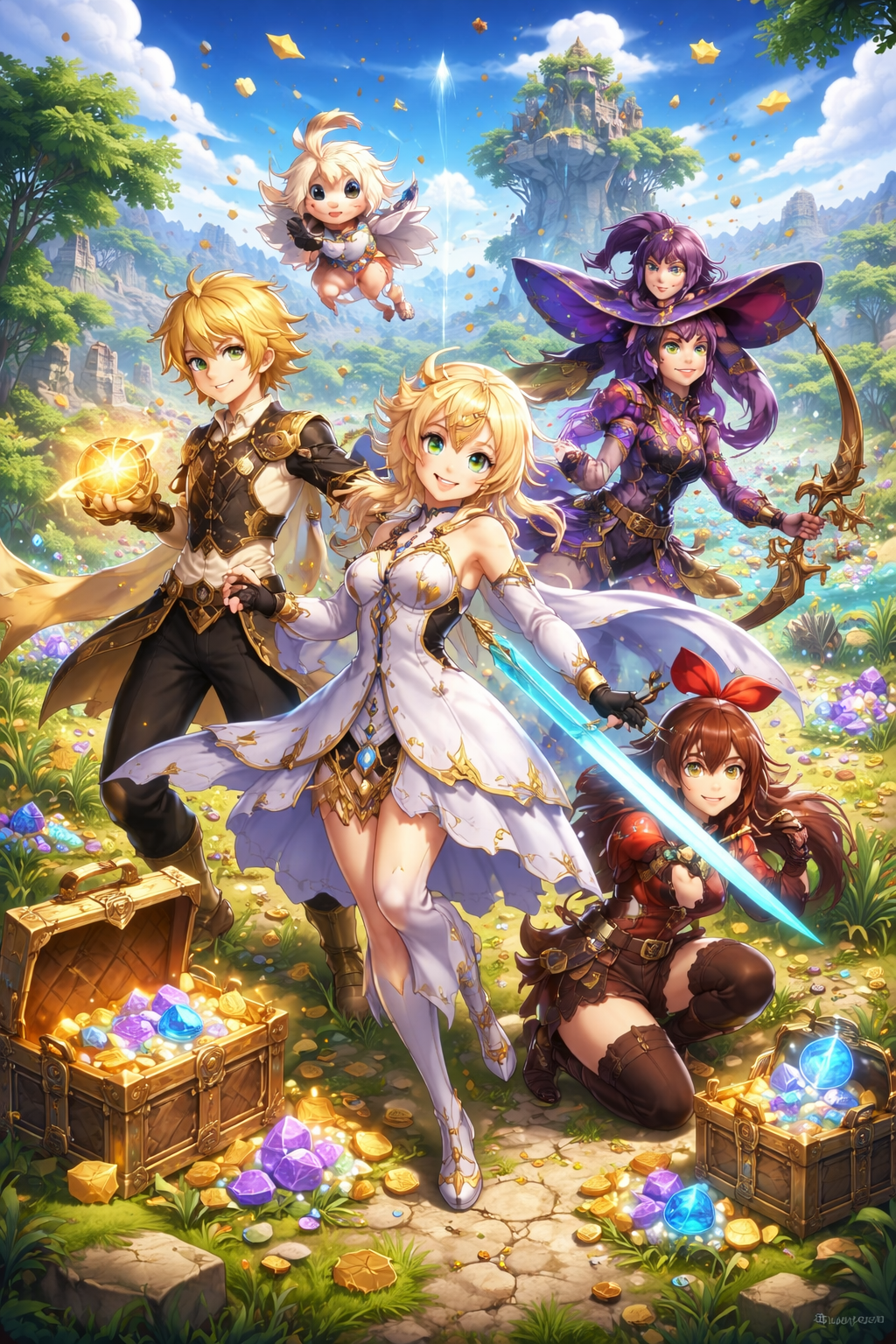
There’s a specific kind of frustration that only Genshin Impact players truly understand. A new banner drops. The character is everything you’ve been waiting for — the perfect fit for your team, a kit that solves problems you’ve been working around for months, and animations that make every other five-star look outdated. You open your wallet of Primogems, do the math, and realize you’re about sixty pulls short of a guaranteed. The banner runs for three weeks. You have two weeks of daily commissions ahead of you. It’s not going to be enough.
This moment — repeated across millions of accounts every patch cycle — is the heartbeat of Genshin Impact’s economy. HoYoverse has built one of the most sophisticated monetization systems in the history of live service games, and understanding how to navigate it is just as important as knowing which artifacts to farm or which team compositions to run.
How Genshin Impact’s currency system actually works
Before talking about top-ups, it’s worth being clear on the structure. The currency you buy with real money is Genesis Crystals, which convert one-for-one into Primogems. Primogems are then exchanged for Intertwined or Acquaint Fates depending on which banner you’re pulling on. Each Fate costs 160 Primogems, and the hard pity guarantee on a five-star sits at ninety pulls — though most players hit somewhere between sixty and ninety depending on their soft pity luck.
There’s also the Welkin Moon blessing, a monthly subscription that delivers ninety Primogems daily for thirty days on top of an immediate Genesis Crystal bonus. It’s widely considered the best value purchase in the game for consistent players — better per-pull value than any single top-up option if you play daily.
Understanding this structure matters because it changes how you think about topping up. You’re not buying characters directly — you’re buying attempts, and the number of attempts you need depends on where your pity currently sits and how unlucky you’re willing to risk being.
Why players choose to top up outside the official store
HoYoverse’s official store works perfectly well, but it’s not the only option — and for many players, it’s not even the most convenient one. Payment method limitations vary significantly by country. Regional pricing differences mean the same amount of Genesis Crystals can cost very different amounts depending on where you’re purchasing from. And sometimes, the simplest reason is that you want the process to be faster and more flexible than what the native app purchase flow allows.
This is where platforms like eldorado.gg have carved out a genuine place in the Genshin community. For players looking to do a genshin top up without the friction that sometimes comes with official channels — declined cards, regional restrictions, slow processing during high-traffic periods like a major patch launch — having a reliable external option changes the experience considerably.
Timing your top-up for maximum value
The single biggest mistake Genshin players make when it comes to topping up is doing it reactively. You see the banner, you fall in love with the character, you scramble to get crystals, and you end up making decisions under pressure that you wouldn’t make with a clear head. This reactive approach is also typically the most expensive one.
The players who manage their Genshin spending most effectively plan by patch cycle, not by banner. Each patch runs approximately six weeks and contains two banner phases. Before a new version drops, the community leaks scene is active enough that you usually have a reasonable sense of what’s coming two or three patches out. That information, used well, lets you start accumulating resources — both from free gameplay and from strategic top-ups — before the character you want is even officially announced.
Eldorado.gg allows you to top up in different amounts, which is useful for players who want to add exactly what they need rather than being locked into predefined bundle sizes. Whether you need a small top-up to close the gap before pity or a larger investment to fully plan a patch cycle, having that flexibility makes the budgeting process considerably more manageable.
What a strategic approach to pity actually looks like
Here’s a framework that experienced Genshin players use that changes everything. Before pulling on any banner, you should know three numbers: your current pity count on that banner, whether you’re on guaranteed or fifty-fifty, and how many pulls you can realistically get before the banner ends.
With those three numbers, you can calculate the realistic range of Primogems you might need. If you’re at sixty pity and on guaranteed, you could get the character in as few as one pull or as many as thirty more. If you’re at zero pity and on fifty-fifty, you’re looking at a realistic range of sixty to one hundred and eighty pulls for a guaranteed outcome — a massive difference that changes completely how much you should invest.
This kind of planning is what separates players who always seem to get what they want from players who feel like the gacha system is working against them. The randomness is real, but it operates within known mathematical boundaries. Work with those boundaries instead of ignoring them.
The constellation question
For most players, getting a character to C0 — their base form — is the goal, and it’s achievable with reasonable investment if you plan properly. Constellations, which require duplicate five-star pulls, are a different conversation entirely.
Some constellations are genuinely transformative — there are characters whose C1 or C2 unlocks a completely different playstyle. Others are marginal improvements that aren’t worth the investment for most accounts. The Genshin community does thorough analysis on every constellation for every character, and reading that analysis before deciding whether to go for C0 or invest deeper is time well spent before any significant top-up decision.
Genshin in 2025 and why the banner calendar has gotten more competitive
HoYoverse’s release cadence has accelerated considerably compared to the early years of the game. New regions, new character archetypes, new weapon types — the content pipeline in 2025 is operating at a speed that the 1.0 playerbase would have found hard to imagine. That acceleration is exciting for the game’s longevity, but it does create more competition for your resources within each patch cycle.
Limited five-stars appear at a higher rate than ever, collaborative characters from outside the game’s universe have become a regular feature, and the weapon banner — historically something most F2P and light spenders avoided — has become more relevant as signature weapons increasingly define how certain characters perform at their ceiling.