
The PlayStation 2 didn’t just arrive, it conquered. When the PS2 hit shelves in 2000 and 2001 across different regions, it fundamentally reshaped the gaming landscape in ways that still echo today. This wasn’t a typical console launch: it was the moment gaming went mainstream, DVDs became household staples, and the hardware wars tilted decisively in Sony’s favor. Understanding the PlayStation 2 release date and what followed opens a window into how a single product can dominate an entire generation and cement a legacy that spans over two decades of cultural impact. For gamers, industry enthusiasts, and anyone curious about how we got here, the PS2’s launch story is essential context.
Key Takeaways
- The PlayStation 2 release date of March 4, 2000, in Japan, October 26, 2000, in North America, and November 24, 2000, in Europe marked a pivotal moment that fundamentally reshaped the gaming industry and mainstream entertainment.
- The PS2’s strategic staggered global rollout allowed Japan to serve as a testing ground while positioning the Western launch perfectly for holiday shopping, establishing Sony’s market dominance before competitors could respond.
- Revolutionary specs like the 128-bit processor, built-in DVD drive, and 3D graphics capabilities, combined with an already-established developer ecosystem from the original PlayStation, made the PS2 nearly impossible to compete with.
- Launch titles like Grand Theft Auto III, Metal Gear Solid 2, and TimeSplitters proved the PlayStation 2 could deliver fundamentally different gaming experiences than previous generations, driving console sales to over 155 million units lifetime.
- The PS2’s online capabilities and DVD functionality extended its appeal beyond hardcore gamers, influencing consumer electronics and entertainment industry standards that persisted for decades.
- Over two decades later, the PlayStation 2 remains culturally significant due to its exceptional game library, affordability on the secondhand market, and continued preservation through emulation, ensuring its legacy influences modern console design philosophy.
When Did The PlayStation 2 Launch?
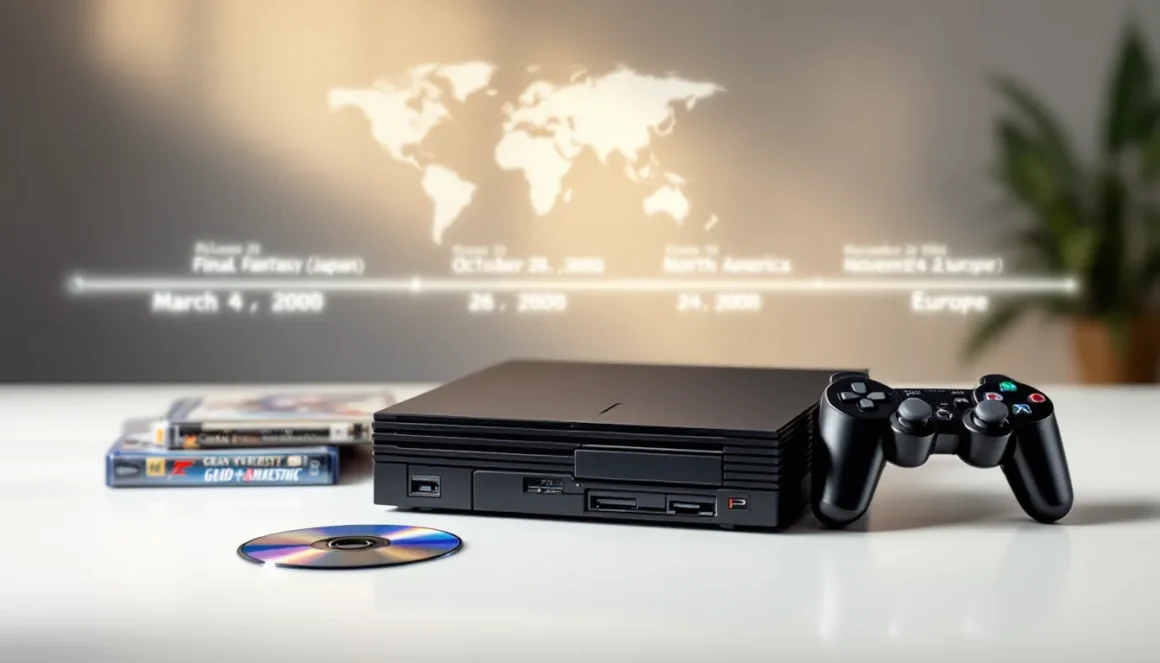
The PlayStation 2’s official launch date varied by region, but the journey began in Japan. Sony released the PS2 in Japan on March 4, 2000, over a year before North American and European gamers got their hands on the console. This staggered approach was intentional: Japan served as the testing ground for what would become the best-selling home console of all time.
North America received the PS2 on October 26, 2000, with Europe following on November 24, 2000. These launch windows were crucial. The console arrived before the holiday season in the West, tapping into peak consumer spending and establishing Sony’s market dominance before competitors could respond effectively. The timing wasn’t accidental, it was strategic positioning at the highest level.
Other regions got later releases throughout 2001 and beyond, but by then, the PS2 had already cemented its place in gaming history. The console would go on to sell over 155 million units lifetime, making it the second best-selling home console ever after the Nintendo DS. That dominance started with those release dates and never relented.
Regional Release Dates Around The World
Japan’s First Taste Of PS2 Gaming
Japan got the PlayStation 2 on March 4, 2000, marking the true genesis of the console era. Tokyo was ground zero for PS2 mania. Long queues formed outside retailers, with gamers desperate to experience the next generation of gaming. Sony had already proven itself with the original PlayStation’s success in Japan, so anticipation for the sequel was astronomical.
The Japanese launch had exclusivity and prestige baked in. Early adopters in Tokyo and other major cities were the first humans on Earth to play titles that would later captivate millions. This gave Japanese developers and publishers a significant head start in understanding the hardware capabilities and market demands. The Japanese launch also featured exclusive titles and a cultural moment that reinforced Sony’s position as the gaming innovator.
North America And Europe Follow Suit
North America received the PS2 on October 26, 2000, almost seven months after Japan. This timing was deliberate. The October launch positioned the console perfectly for the Black Friday and holiday shopping rush. Retailers stocked up aggressively, knowing demand would be fierce. Early American PS2 owners had experienced plenty of buzz from Japanese imports and gaming magazines, making the official launch feel like the culmination of months of anticipation.
Europe’s PS2 launch came just four weeks later on November 24, 2000. The European market, already established from the original PlayStation’s success, embraced the PS2 with similar fervor. By this point, developers had clearer software strategies ready for Western audiences. The staggered global rollout meant that by the time the console reached Europe, the library was stronger and the hardware proven by real-world usage.
Other Territories And Delayed Releases
Australia and other Pacific regions received the PS2 in 2001, along with South Korea, Canada, and various smaller markets. Some territories didn’t get official releases until 2002 or later, though grey imports and region-hacked consoles helped bridge those gaps. The gradual global rollout meant different regions experienced slightly different launch libraries and market conditions, but the core narrative remained the same: the PS2 was taking over, region by region.
The Pre-Launch Hype And Anticipation
Before the PlayStation 2 release date even arrived, hype had already reached fever pitch. The original PlayStation had proven that 3D gaming was the future, and Sony was doubling down on that promise. Developers were promising games with graphics that looked almost cinematic, gameplay depth that rivals called impossible, and online connectivity that would change multiplayer forever.
Gaming magazines like Game Informer and other outlets covered every rumor, every leaked spec, every developer interview. The graphics processing power, 128-bit architecture, DVD drive, Emotion Engine processor, sounded like science fiction compared to the competition. Nintendo was still riding the wave of the Nintendo 64, which was aging poorly in the 3D space, while Sega’s Dreamcast, even though its innovation, couldn’t match the manufacturing scale and third-party support Sony was securing.
The DVD angle added another layer of intrigue. The PS2 would play DVD movies, not just games. In 2000, DVD players were expensive standalone devices: having that functionality built into a console was revolutionary. This positioning pulled in audiences beyond hardcore gamers, parents, movie enthusiasts, and casual consumers saw value in the hardware beyond gaming.
Japanese media outlets had been tracking PS2 development for years, and when the actual release date was announced, retailers couldn’t keep units in stock. Import copies made their way to North America and Europe, driving even more excitement. The months leading up to October 2000 in North America and November 2000 in Europe felt like waiting for a major cultural event. This wasn’t just a new console: this was the future of entertainment arriving.
What Made The PS2 Special At Launch
The PS2 arrived with specs that seemed almost impossible at its price point. A 128-bit processor, DVD drive, built-in graphics processor, and support for 3D polygon rendering at scales the previous generation couldn’t touch. From a hardware perspective, it was a generational leap. Games could have environmental detail, character animation, and draw distances that made the N64 feel ancient by comparison.
But raw specifications don’t win console wars. The PS2’s real advantage was the ecosystem Sony had cultivated. The company had already spent five years building relationships with developers through the original PlayStation. Publishers had made millions on PS1 games and weren’t about to abandon that success for unproven competitors. When the PS2 launched, the software roadmap was already packed.
Online capabilities were promised, though they didn’t arrive at launch. The Network Adapter came later in 2002, but gamers knew it was coming. That forward-thinking positioning, showing that the console could evolve and connect to online services, differentiated the PS2 from competitors who seemed locked in time. The DVD functionality also legitimized the purchase for households where gaming might otherwise be a hard sell.
Region locking existed, but it was looser than competitors’ implementations. The ability to mod the system became easier with each revision, which, while not officially endorsed, kept hardcore gamers invested in the platform. The community aspect of PS2 ownership extended beyond just the software: it was about being part of something bigger that would define an entire generation.
Launch Titles That Changed Gaming
A console’s worth is often measured by its launch library, and the PS2 arrived with some genuinely groundbreaking games that would define the system’s early years.
TimeSplitters came to PS2 and set a new standard for first-person shooters on console. The gunplay felt responsive, the framerate held up in multiplayer, and the design showed that 3D shooters weren’t just a PC phenomenon anymore. SSX launched with technical flash, snowboarders catching air, performing tricks, and racing down mountains with environmental detail that seemed impossible on previous hardware. Madden NFL 2001 and NBA Live proved that sports franchises would thrive on the new generation with polygonal athletes and improved AI.
But the real killer app came later in the launch window: Grand Theft Auto III. When it arrived just weeks after the console’s North American launch, GTA III became synonymous with the PS2’s capabilities. The open world, the freedom, the narrative scope, this was a game that couldn’t exist on previous hardware. It didn’t just move PS2 units: it defined what the console would become. Stores sold out, black market pricing shot up, and GTA III became the must-have experience that pulled in millions of casual players.
Metal Gear Solid 2: Sons of Liberty released a few months later and pushed the narrative ambitions of gaming forward. The franchise proved it could evolve beyond the original’s stealth excellence, and the game showcased technical prowess and storytelling complexity that rivaled film and literature.
These weren’t just good games, they were statement pieces that proved the PS2 wasn’t just more powerful, but fundamentally capable of different kinds of gaming experiences than what came before.
How The PlayStation 2 Impacted The Gaming Industry
The PlayStation 2’s release date and subsequent dominance rewrote the rules for how the gaming industry operated. When the PS2 sold 10 million units in its first year, it became clear that Sony had shifted the entire landscape. Publishers poured resources into PS2 development. Third-party support, which was critical to the original PlayStation’s success, became even more essential for the PS2’s explosive growth.
Competitors had to respond. Sega discontinued the Dreamcast in 2001, effectively ceding the console space. Microsoft, watching the PS2 phenomenon, accelerated development of the original Xbox, which launched in 2001 in North America. Even with a one-year head start, the PS2’s momentum was impossible to match. The Xbox would have a successful run, but the PS2 always felt like the market leader, the platform where major releases were optimized and where the community thrived.
The online capabilities that arrived with the Network Adapter in 2002 essentially created online console gaming as we know it today. Games like Final Fantasy XI and later Metal Gear Solid Online showed that persistent online worlds and competitive multiplayer could thrive on consoles, not just PCs. This shift had massive implications for how the industry would develop MMOs, live-service games, and online infrastructure.
Developers also had to contend with the DVD format becoming standard through the PS2. This accelerated the adoption of DVD as the home video format, which had ripple effects throughout the entertainment industry. The PS2 wasn’t just a gaming device, it was a cultural artifact that influenced consumer electronics, media consumption patterns, and how companies approached home entertainment.
According to Video Game Chronicles, the PS2’s influence on third-party publishing strategies and release windows fundamentally changed how the industry coordinated major title launches. The console’s success established patterns we still see in AAA game development today.
Why The PS2 Remains A Gaming Legacy Today
Over two decades after its release date, the PlayStation 2 remains relevant in gaming culture for several reasons. The library is legitimately one of the best ever assembled. Franchises like Metal Gear, Grand Theft Auto, Final Fantasy, Kingdom Hearts, Devil May Cry, Resident Evil, and countless others produced some of their best entries on the PS2. If you’re looking for a system with an absurdly deep catalog of quality games spanning every genre, the PS2 is it.
The console is also relatively affordable on the secondhand market. Used PS2s go for reasonable prices, and games are cheap. For retro gamers and new players wanting to experience one of gaming’s greatest eras without very costly, it’s accessible. The hardware aged reasonably well, not as gracefully as, say, the SNES, but better than many from its generation.
Emulation has also kept the PS2 alive. Gematsu and other Japanese gaming sources have tracked how the PS2 community continues to grow through emulation on PC and Android devices, allowing players to revisit classics and experience the library with enhanced graphics through upscaling. This preservation effort has ensured that the PS2’s catalog doesn’t disappear as hardware degrades.
Culturally, the PS2 era represents a specific moment in gaming history. The mid-2000s PS2 peak, dominated by action games, stealth games, Japanese RPGs, and ambitious AAA titles, feels distinct from the live-service, always-online landscape we inhabit now. Nostalgia for that era runs deep among millennials who grew up with the console. The PlayStation 2 release date marked the beginning of an era that defined how millions of people experienced gaming, and that cultural weight hasn’t faded.
Conversely, Game Informer has documented how the PS2’s legacy influences modern console design philosophy and how developers approach library building. The lessons learned from the PS2’s success shaped strategies for every PlayStation console that followed, and its impact extends to how competitors approach their own platforms.
Conclusion
The PlayStation 2 release date, March 4, 2000, in Japan, October 26, 2000, in North America, and November 24, 2000, in Europe, marks a historical inflection point for interactive entertainment. From that moment, the gaming industry followed a trajectory that the PS2 had essentially charted. The console didn’t just win a generation: it defined what that generation looked like, sounded like, and played like.
The PS2 succeeded because of timing, specs, games, and ecosystem. It was powerful enough to matter, had the library to back it up, arrived at the right moment in console cycles, and benefited from Sony’s foresight in securing third-party support. But eventually, its legacy persists because the games created on that hardware remain genuinely great. From GTA III to Shadow of the Colossus to Final Fantasy X, the PS2 hosted some of gaming’s finest moments.
For anyone exploring gaming’s history or looking to understand how we got to today’s gaming landscape, the PS2’s story is essential. That release date in 2000 didn’t just launch hardware, it launched a generation that still influences gaming culture, console strategy, and player expectations today. The PlayStation 2 remains gaming’s most important home console, and its impact shows no signs of fading anytime soon.