
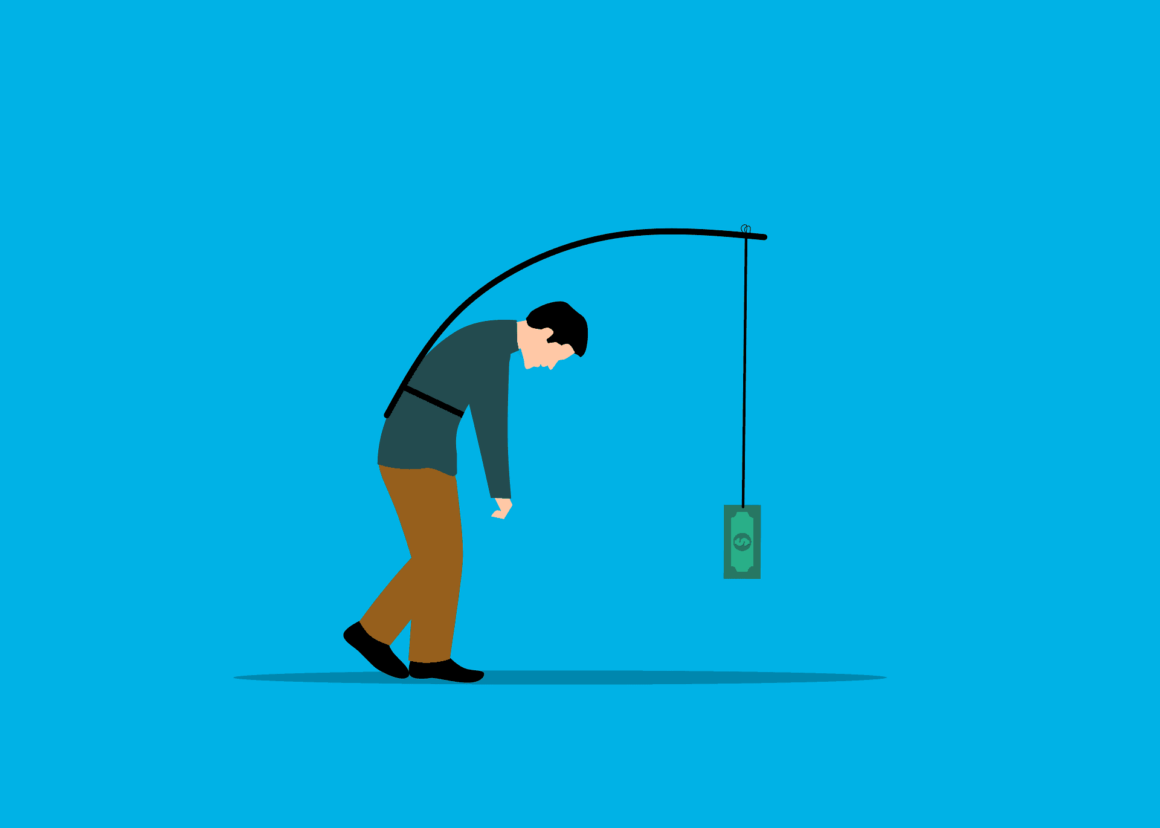
Everyone has done it at some point, because you lose a little and then try a little harder to win it back, only to lose a bit more and double down without thinking. Before you realise what is happening, a small loss has turned into something much bigger than you ever intended. This behaviour has a name: chasing losses, and it feels perfectly logical in the moment because you are just trying to get back to zero. But chasing losses almost never ends well, and it is one of the fastest ways to turn a bad situation into a complete disaster. Understanding why this happens is the first and most important step to stopping it before your bankroll gets destroyed.
What “Chasing Losses” Actually Means
Most people think chasing losses simply means increasing your bets after a loss to recover quickly, but the real definition is broader and much more dangerous. Chasing losses is any attempt to win back money you have already lost by continuing to play, often with bigger risks or worse decisions than you would normally make. It is not just about raising your stake, because it can also mean playing longer than planned, switching to games you do not understand, or borrowing money to keep going.
The key feature of chasing is that your decision is driven by past losses rather than logic, which changes everything about how you play. You are no longer thinking about entertainment or strategy, but instead you are thinking about revenge against the game that took your money. The sad truth is that chasing almost never works because the math is simply not on your side.
Here is a simple example. Imagine you walk into a casino with $100 and lose $20 on a slot machine. A non-chaser would accept the loss, cash out $80, and leave. A chaser puts another $20 into the same machine hoping to win back the original $20, and if that loses they might put $40 next. The loss grows exponentially while the chance of recovery shrinks, yet most people do not even notice when they cross the line from playing to chasing.
The Hidden Trap Of Small Losses
Small losses are actually more dangerous than big ones, because a large loss often shocks people into stopping since the pain is immediate and obvious. But a small loss feels manageable, so you tell yourself it is only $10 or $20 and you can easily win that back in one round without much trouble. That thinking is the trap, because small losses lower your guard and make chasing feel reasonable when it is anything but reasonable. One small loss leads to another small loss, and suddenly you are down $100 without a single big losing hand to blame for your situation. The chase started so gently that you did not even feel it start, which is exactly why small losses are so dangerous to your bankroll.
The Psychology That Makes Smart People Do Dumb Things
Chasing losses is not a sign of stupidity, because very intelligent people fall into this pattern all the time without exception. The reason is that chasing exploits basic features of how human brains process risk, reward, and loss in ways that bypass our rational thinking. Once you understand these psychological tricks, it becomes easier to see why chasing feels so natural.
The Fresh Start Fallacy
The fresh start fallacy is the belief that one win will somehow erase everything that came before it, so a chaser thinks they just need to win back their $50 to be back at zero. That sounds reasonable on the surface, but it ignores a critical detail: the past losses have already happened and cannot be erased by anything. Winning $50 later does not erase them, because it just adds a win after a loss, and the net result is still zero. The fresh start does not exist, because every bet stands on its own and chasing just tricks you into treating a series of bets as one connected story.
Losses Feel Stronger Than Wins
Psychologists have known for decades that losses hurt about twice as much as wins feel good, and this imbalance is called loss aversion. Losing $10 feels significantly worse than winning $10 feels good, which is why chasing is so tempting for almost everyone. The pain of the loss creates a strong urge to do something to make that pain go away, and winning is the most obvious solution that comes to mind. So you bet again, not because you expect to win, but because the alternative of simply sitting with the loss feels unbearable.
A Simple Math Problem That Explains Everything
Let us walk through a very basic numbers game to show why chasing almost never works, using a fair coin flip where heads wins $10 and tails loses $10. You start with $100 and lose three times in a row, so now you are down to $70 and your brain wants to win back that $30 as quickly as possible. If you keep betting $10 each time, you need three wins in a row to get back to $100, but the chance of three consecutive wins is only 1 in 8, or 12.5%, which is not great at all.
So you decide to chase more aggressively and double your next bet to $20, because if you win you recover $20 of the $30 loss in one single go. But if you lose that $20 bet, you are down $50 total and need even more to recover, so you double again to $40. After four losses in a row with doubling, you would be betting $160 just to recover a $30 original loss, and at that point you no longer have enough money to cover the next bet. The chase collapses not because of bad luck, but because of simple arithmetic, since the odds do not change just because you are losing.
Why The House Edge Makes Everything Worse
In a real casino, the odds are not 50/50 because the house has an edge on every single game you can play. That edge is small on some games like blackjack (around 0.5% with perfect play) and large on others like slots (5–10% or more). The edge does not disappear when you are chasing, because it applies to every single bet you make regardless of your emotional state. So not only are you facing the same mathematical problem as the coin flip example, but you are also losing a small percentage on every bet to the house. Over time, the house edge guarantees that chasing will lose more money than it recovers.
Three Scenarios Where Chasing Made Everything Worse
These scenarios are fictional but based on patterns that happen every single day in casinos and online platforms around the world.
The slot player who could not stop. A woman loses $20 on a slot machine, puts in another $20 and wins back $15, so she is now down only $5. Instead of walking away, she decides to play for a small profit, loses the next $20, then another $20. Two hours later, she lost $300, turning the original $20 loss into fifteen times that amount.
The poker player on tilt. A man loses a big hand with pocket aces and feels cheated by luck, so he stays at the table longer than planned. He starts playing hands he would normally fold, loses again, then raises recklessly to intimidate other players. In one hour, he loses four times what he lost on the original hand.
The online player chasing deposit bonuses. A player signs up with a small deposit and loses it quickly, so he deposits again to chase the loss, then again. He starts using bonus offers thinking free spins give him an advantage, but bonuses come with wagering requirements. The original loss was $50, but the final loss after three deposits was over $400.
What To Do Instead
The good news is that stopping the chase is simple, but simple does not mean easy, because you just need a few clear rules that you follow without negotiation.
Set a loss limit before you start playing, decide how much you are willing to lose in a session, and when you hit that number you stop immediately. Never borrow money to play, because credit cards, loans, and borrowing from friends all turn a small loss into debt that is much harder to fix. Take a break after any loss, even a small one, by standing up and walking away for ten minutes to let your brain reset. Treat every session as independent, because what happened last time or five minutes ago does not matter at all. Use tools like deposit limits and loss limits if you need them, because these tools are guardrails, not punishments.
A Smarter Way To Play
Chasing losses happens when players do not have clear boundaries before they start, which is why the smartest approach is to decide your limits first. Using a Stay Casino sign up bonus at the beginning of your session, not after a loss, sets the right tone for responsible play. You are playing with a plan, not chasing an emotional recovery, which makes all the difference. The best time to think about limits and budgets is before you place the first bet, not after you have already lost.
FAQ
What does chasing losses mean in simple terms?
It means trying to win back money you have already lost by continuing to play, often with bigger bets or worse decisions than you would normally make. It is almost always a bad idea.
Why is chasing losses so common?
Because losses hurt more than wins feel good, so the pain creates a strong urge to do something about it immediately. Playing again feels like the most direct action you can take.
Can you ever win back losses by chasing?
Sometimes, yes, in the short term, but over time the math and the house edge make it a losing strategy. For every person who chases and recovers, many more lose much more.