
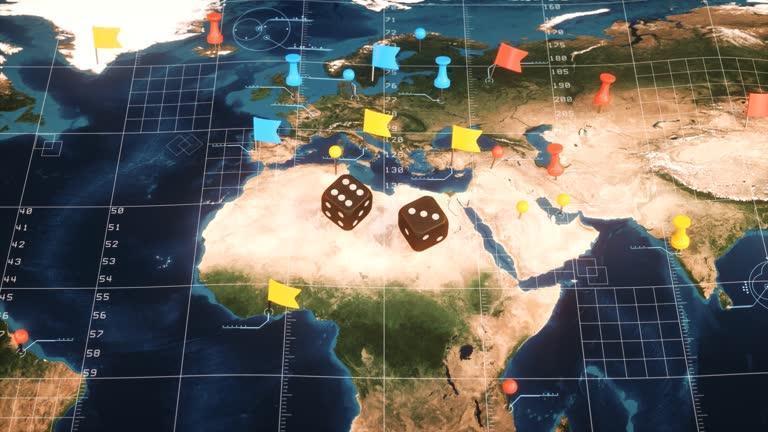
Game worlds are becoming larger, more varied and increasingly difficult to build entirely by hand. Procedural generation is giving developers another option. Instead of creating every environment manually, studios can use systems that assemble terrain, layouts and other elements dynamically. The result is not simply bigger games but new ways of thinking about exploration, replayability and creative control.
Procedural Design Changes How Worlds Are Built
Traditional level design gives developers precise control over every detail.
A designer can decide where a building appears, how a path curves and when the player encounters a particular challenge. This approach is ideal when pacing and storytelling depend on carefully arranged spaces.
Procedural generation works differently.
Developers create rules and systems that determine how parts of the world are assembled. Those rules can generate different environments each time or help teams produce large amounts of content more efficiently.
This technique has existed for decades but modern hardware and development tools allow studios to use it in more ambitious ways. It can now influence terrain, weather systems, item placement and entire world layouts.
The important point is that procedural design does not remove creativity.
It changes where the creative work happens.
Instead of manually placing every object, designers decide which rules control the system. They define what combinations are possible and which outcomes should never occur.
Replayability Becomes Part of the Design
One of the clearest benefits is variation.
When a game can rearrange locations, challenges or rewards, players may encounter something different each time they return. This is particularly useful in roguelikes, survival games and exploration-focused titles.
The approach also connects with broader digital entertainment trends.
Users increasingly expect platforms to offer large amounts of content while still making each session feel distinct. Online gaming services face the same challenge. A platform such as Slotsoo exists within an entertainment market where players can choose among many different slot themes, mechanics and live casino experiences, making variety an important part of discovery.
Procedural systems take that idea further by generating variation inside the game itself.
This can reduce predictability and encourage players to experiment with new routes or strategies.
However, randomness alone does not create a good experience.
A completely unpredictable world can feel confusing or repetitive in the wrong ways. Strong procedural design still needs structure. Players should feel that the environment makes sense even when it has not been assembled manually.
Designers Are Building Systems Instead of Scenes
Procedural development changes the role of the designer.
In a hand-built level, the designer is effectively arranging a specific sequence of spaces. In a procedural project, the designer may spend more time creating rules that can produce thousands of possible variations.
This requires a different type of creative thinking.
Designers need to consider probabilities, boundaries and relationships between elements. If a forest can generate beside a village, the system needs rules about terrain transitions. If enemies appear dynamically, their placement still has to respect difficulty and pacing.
Testing also becomes more complicated.
A handcrafted level can be checked repeatedly because it stays the same. A procedural system may produce rare combinations that developers did not expect.
This means teams often need stronger tools for simulation and automated testing.
They may generate large numbers of worlds to identify unusual layouts, broken paths or combinations that feel unfair.
The creative process therefore becomes partly about designing the generator and partly about controlling its output.
Procedural Tools Can Support Smaller Studios
Large game worlds are expensive to produce.
Environment artists, level designers and technical teams may spend years creating locations for major releases. Smaller studios rarely have the same resources.
Procedural tools can help close that gap.
A small team can create systems that produce far more environmental variety than the developers could build manually. This does not eliminate the need for artists or designers. It allows their work to scale.
A studio might create a limited number of building components and then use rules to combine them in many different ways. Terrain generation can fill large areas while artists focus on major landmarks.
This hybrid approach is becoming especially valuable.
Purely procedural worlds can sometimes feel generic because the system lacks the intentional details of handcrafted spaces. Combining generated content with carefully designed locations can offer both scale and personality.
The strongest games often use automation where it saves time while preserving manual design where it matters most.
Bigger Worlds Are Not the Only Goal
Procedural generation is sometimes discussed as a tool for making enormous games but size is not necessarily its most interesting benefit.
The real opportunity is variability.
Developers can create environments that respond differently each time, making exploration less predictable and allowing systems to interact in ways that even the designers may not fully anticipate.
That can create memorable player stories.
Two people may play the same game yet encounter different layouts, resources and challenges. Their experiences become personal without requiring developers to script every possibility.
The challenge is maintaining quality across all those outcomes.
Procedural technology is therefore unlikely to replace traditional level design. It is becoming another creative tool alongside it.
For game developers, that opens a valuable middle ground. Worlds can remain intentional without being entirely fixed and they can become larger without requiring every detail to be placed manually.
The future of procedural design may be less about infinite worlds and more about giving designers better ways to create variation at scale.