

If you have been eyeing a high-tier set or a glowing garage door, you might naturally head straight to the official Steam marketplace. However, there is a secret that veteran traders have used for years: the Steam Community Market is often the most expensive place to build your loadout. For players looking for the best value, the real deals aren’t found in the Steam client, but on third-party platforms that operate outside Valve’s closed-loop economy.
The reason for this price discrepancy comes down to what traders call the “Steam Tax.” When you buy or sell an item on the official market, Valve and the game developer collect a combined 15% transaction fee. While this provides a safe and integrated experience, it effectively inflates the price of every item. Furthermore, any money you earn from selling skins is locked into your Steam Wallet. Since you cannot withdraw those funds as real cash, the value of a Steam dollar is technically lower than a real-world dollar, which often leads to artificially higher listing prices.
By moving to external marketplaces, you unlock major advantages that the official market simply cannot match. Because sellers on these sites can withdraw their earnings to a bank account or crypto wallet, they are often willing to list items for 20% to 30% less than the Steam price. These platforms also offer massive inventory variety and the ability to “trade up” bulk items—swapping dozens of low-value skins for one high-tier piece in a single transaction. The goal is to show you exactly where to purchase RUST skins safely while avoiding the pitfalls of the secondary market, ensuring your budget goes much further every single wipe.
The Two Types of Marketplaces (Bot vs. P2P)
Navigating the world of third-party skins in 2026 requires understanding the two primary ways these platforms handle your items. Depending on whether you prioritize speed or the absolute lowest price, you will find yourself choosing between automated bot services and direct peer-to-peer (P2P) exchanges.
Instant Bot Trading: Speed and Convenience
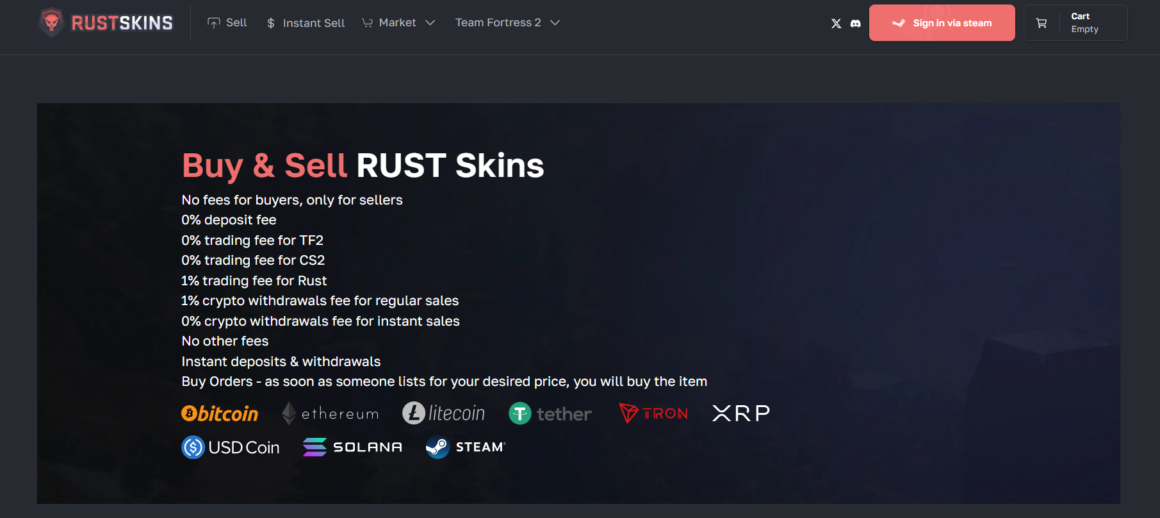
Bot-based platforms like SkinsMonkey, Tradeit.gg, and RustSkins function as centralized digital warehouses. These sites maintain their own massive inventories of skins across thousands of automated Steam bot accounts. When you want to buy or trade, you aren’t dealing with another person; you are interacting with a program that can finalize a deal in under 30 seconds.
This model is the gold standard for “instant gratification.” If you have a pile of low-value “junk” skins—the common drops and duplicates from hundreds of hours of gameplay—these sites allow you to “trade up” by dumping your bulk inventory in exchange for one high-quality piece in a single, seamless transaction. While the prices are slightly higher than P2P markets to account for the site’s operating costs, the ease of use and zero-wait delivery make them the favorite for 90% of casual traders.
Peer-to-Peer (P2P) Marketplaces: Maximum Value
P2P marketplaces like Skinport and DMarket take a different approach. Instead of holding the items themselves, they act as a secure infrastructure that connects buyers and sellers directly. When you buy a skin on these platforms, the item often remains in the seller’s Steam inventory until the moment of purchase, at which point the site’s escrow system facilitates the trade and holds the funds until both parties are satisfied.
Because these sites don’t have to manage massive bot fleets or “buy” inventory from players, they can offer significantly lower fees. Sellers on P2P platforms often compete aggressively on price to ensure their listings stand out, which is why you can frequently find high-tier Rust sets for 25–35% less than their Steam Community Market value. If you are a patient buyer looking to secure rare armor sets or expensive weapon skins at their absolute floor price, the P2P route is unbeatable.
Top-Rated Rust Marketplaces for 2026
While there are dozens of sites competing for your attention, a few industry leaders have solidified themselves in 2026 as the gold standard for Rust traders. These platforms are celebrated for their security, massive inventories, and user-centric features that make upgrading your loadout a seamless experience.
As you compare platforms, details like fees, liquidity, and small extras can make a real difference over time. Even something simple like using a Duel referral code can add a bit of extra value on the margins, especially when you’re making multiple trades.
Skinport: The “Safest Bet”
Consistently ranking as a top-tier marketplace, Skinport maintains an impressive 4.7/5 rating on Trustpilot and is widely regarded as the most user-friendly platform for newcomers. It operates with a polished, e-commerce feel that removes the complexity from skin trading.
One of the biggest perks of Skinport is the zero buyer fees policy—the price you see is exactly what you pay at checkout. Because it is a regulated EU marketplace, it offers a secure escrow system that protects every transaction, making it the perfect place to safely purchase high-value items like rare armor sets or legendary weapon skins.
SkinsMonkey: The “Trade King”
If you’re looking to refresh your inventory instantly, SkinsMonkey is the undisputed leader for automated trading. In 2026, it remains a fan favorite thanks to its incredible 35% deposit bonus, which provides a massive boost to your trading power.
This site is optimized for “trading up.” It features a near-99% acceptance rate for low-tier items, allowing you to dump a pile of “junk” skins and walk away with a high-tier AK or a tactical camouflage set in seconds. Its automated bot system ensures that you don’t have to wait for a human seller to accept your offer, offering true instant gratification.
DMarket: The “High-Volume Giant”
DMarket is a powerhouse in the digital skins economy, boasting millions of active users and a turnover that ensures deep liquidity. For serious players who want a professional-grade experience, DMarket offers some of the most advanced sorting and bidding tools in the industry.
Beyond its massive Rust inventory, DMarket is praised for its transparency and low fees (often as low as 2%). The platform supports “Face-to-Face” trading, which allows you to sell items while keeping them in your inventory until the moment of the deal. This keeps your skins usable in-game right up until they find a new home.
RustSkins: The “Specialist”
While many marketplaces juggle multiple games, RustSkins has earned its reputation by focusing almost exclusively on the Rust community. This dedication allows them to offer a tailored browsing experience that you won’t find on broader gaming sites.
Their interface is uniquely designed for the Rust player. They offer specialized categories for building-related skins, making it incredibly easy to find matching sets for Garage Doors, Large Boxes, and Furnaces. If your goal is to perfectly color-coordinate your entire base, this specialist approach saves you hours of filtering through unrelated items.
Why These Sites are Cheaper Than Steam
If you have ever compared prices between the official Steam Community Market and a third-party site, you likely noticed a massive gap—often as much as 20% to 30%. This isn’t a glitch; it is the result of a more open and competitive digital economy. When you look for where to buy RUST skins, understanding these three factors will help you see why external marketplaces consistently offer the best value for your money.
Real-World Cash Liquidity
The primary driver of lower prices on third-party sites is “cash liquidity.” On the official Steam market, when you sell a skin, the proceeds are locked into your Steam Wallet. Since these funds can only be spent on more skins or games within Valve’s ecosystem, they don’t have the same utility as “real” money. Conversely, third-party sites allow sellers to withdraw their earnings directly to a bank account, credit card, or cryptocurrency wallet. Because sellers value this flexible, real-world cash more than “Steam bucks,” they are willing to list their items at a significant discount to attract buyers quickly.
Fierce Market Competition and Bonuses
Unlike the Steam market, which has no direct competition within its own app, third-party sites are in a constant battle for your business. To stand out, these platforms offer aggressive incentives that you won’t find on the official store. Many top-rated sites in 2026 offer deposit bonuses ranging from 30% to 35%, effectively giving you free credit just for choosing their platform. Additionally, because these sites often charge much lower seller fees—sometimes as low as 2–5% compared to Steam’s 15%—sellers can lower their prices and still walk away with more profit than they would have made on the official market.
Elimination of the “Wallet Lock”
The Steam ecosystem is a “closed loop,” meaning once money enters, it rarely leaves. This creates an environment where prices are naturally higher because the currency is less versatile. Third-party marketplaces break this lock, allowing you to move your capital freely. If you decide to move from Rust to a different game—or if you simply want to turn your unused inventory back into grocery money—these sites provide the infrastructure to do so. This freedom of movement attracts a high volume of active traders and “quick-sellers,” ensuring that there is always a fresh supply of undervalued skins ready for a savvy buyer to snag.
The Golden Rules of Safety (Avoiding Scams)
Trading in the Rust skin market is highly rewarding, but in 2026, scammers have become more sophisticated in their attempts to intercept your trades. Protecting your inventory requires more than just a strong password; it requires a deep understanding of the “Red Flags” that distinguish a legitimate marketplace from a phishing trap. By following these three golden rules, you can ensure your assets stay exactly where they belong.
The API Key Check: Your Digital Shield
The most common high-tier scam in the current market is the API Key Hijack. In this scenario, a scammer uses a compromised API key to monitor your account; the moment you initiate a legitimate trade, they use a bot to cancel it and send an identical-looking fake offer to their own account.
To stay safe, remember that a legitimate trading site will never ask you to provide your Steam API key or your Steam password directly. They use the official Steam OpenID portal, which allows you to “Sign In” with a single click if you are already logged into Steam in your browser. If a site asks you to manually enter an API key or “verify” your account by providing a 2FA code outside of the official Steam login pop-up, close the tab immediately. You can check the status of your API key at any time by visiting the official Steam Web API page; if there is a key there that you didn’t create, revoke it instantly.
URL Verification: Don’t Fall for the “Clone”
Phishing sites in 2026 are nearly indistinguishable from the real thing, often copying the layout, live chat, and even the Trustpilot badges of top sites like Skinport or SkinsMonkey. These “Clones” rely on typosquatting—using a URL that is one letter off, such as skinp0rt.com or skinsm0nkey.net.
Never click on sponsored ads in search results, as scammers often pay to have their phishing sites appear at the very top. Instead, manually type the URL into your browser or use a trusted link from a verified community discord. If you are already logged into Steam on your browser and a site asks you to “Log In” again with your username and password, it is almost certainly a phishing attempt.
The “Join Date” Test: Know Your Trading Partner
When you receive a trade offer from a site’s bot, your Steam Mobile Authenticator provides a wealth of information that can save your skins. Scammers can easily copy a bot’s name (e.g., “SkinsMonkey Bot #142”) and its profile picture, but they cannot fake the account’s history.
Before hitting “Accept,” check the bot’s Steam profile. A legitimate bot from a major marketplace will be an established account—usually Level 10 or higher with a “Member Since” date that goes back several years. If the “bot” sending you an offer has a private profile, is Level 0, or was created only a few weeks ago, it is a scammer account. Take your time to verify these details; a split-second check of the registration date is the ultimate defense against impersonation.
Step-by-Step: Making Your First External Purchase
Now that you know which platforms to trust, the actual process of acquiring your first set of skins is simple. By following these steps, you can move from a default survivor to a fully kitted specialist in minutes, all while ensuring your account remains 100% secure.
Login & Security: Setting Up the Connection
Legitimate marketplaces in 2026 utilize Steam OpenID, a secure portal that allows you to sign in without ever sharing your password with the third-party site. If you are already logged into Steam in your browser, you will simply see a green “Sign In” button.
Once logged in, you must provide your Trade URL. This is a unique link that allows the site’s automated bots to send you trade offers directly. You can find this link in your Steam profile under Inventory > Trade Offers > Who can send me Trade Offers?. Copy this URL into the marketplace’s settings. This establishes a “handshake” between the site and your Steam account, ensuring that any skins you buy are sent to the correct person.
The Deposit Process: Funding Your Loadout
Third-party sites offer significantly more flexibility than the Steam Wallet. In 2026, most top-rated platforms like SkinsMonkey and RustSkins support three main ways to add balance:
- Card & Digital Payments: You can use standard Visa/Mastercard or even mobile payment options. Many sites offer a 30% to 35% deposit bonus when using these methods, instantly increasing your buying power.
- Cryptocurrency: For those seeking the fastest and most private transactions, many sites accept Bitcoin, Ethereum, or Litecoin.
- Skin Trade-Ins: This is the most popular method for Rust players. You can select “junk” skins from your own inventory and “sell” them to the site for instant credit. The platform will evaluate your items based on real-time market data, allowing you to swap a pile of unwanted duplicates for a high-tier set in a single transaction.
Accepting the Trade: The Final Verification
Once you have selected your new skins and clicked “Withdraw” or “Accept Trade,” the site will dispatch an automated bot to send you the items on Steam. You will receive a notification on your Steam Mobile Authenticator. This is the most critical moment for security.
A legitimate trade offer from a trusted site will include a Unique Security Code on the website’s dashboard that must match the message in the trade offer on your phone. Before hitting “Accept,” verify the bot’s identity: it should be a high-level Steam account (Level 10+) that has been active for several years. If the security codes match and the bot’s profile looks established, confirm the trade. Your new skins will be added to your inventory instantly, ready to be equipped at the next repair bench or crafting session.
Conclusion
Building a high-tier inventory in 2026 doesn’t have to break your budget. By stepping outside the official ecosystem, you gain access to a global market where real-world cash liquidity and fierce competition work in your favor. Whether you are looking for a rare glowing iron sight to win your next nighttime raid or a full set of desert camo to vanish into the dunes, the third-party market offers a level of value and flexibility that the Steam Community Market simply cannot match.